Youth consumer trends are only useful when they reveal something a brand can act on.
Most trend reports tell you what is already visible. By the time a behaviour is obvious enough to name, the people who gave it meaning may have moved on. This report focuses instead on shifts evidenced through NERDS’ own youth consumer research: how young consumer behaviour is changing, what the data shows and what it means for brands.
NERDS is a youth research agency and Gen Z marketing agency that helps brands understand the communities shaping what comes next. The findings in this report are powered by Frontline, NERDS’ proprietary research engine, built on 15 years of structured intelligence, more than 36,000 conversations and an active network of 3,400 cultural contributors.
Across eight youth consumer trends, we examine how trust, influence and desire are changing among young consumers, and what each shift means for brands. This report is reviewed periodically as new Frontline evidence becomes available.
Quick Navigation
- How we identified these youth consumer trends
- Youth Culture Is Moving Into Private Online Spaces
- Young Consumers Validate Purchases Before Buying
- Verified Reviews and Trusted Retailers Build Brand Credibility
- Young Consumers Want Distinctive Brands, Not Just Limited Drops
- Luxury Alone No Longer Defines Aspiration for Young Consumers
- Peers Influence Young Consumers More Than Celebrities
- Youth Culture Trends Differ by Market and Community
- Young Consumers Expect Brands to Earn Cultural Legitimacy
- What is not changing
- How brands should use youth trend research
- FAQs
How We Identified These Youth Consumer Trends
In our youth consumer research, we primarily use ‘youth’ to refer to people aged 16-25. Where a supporting Frontline study covers a broader 16-35 cohort, we state the age range alongside the finding rather than presenting the full sample as Gen Z.
This article draws primarily on the Frontline Fashion & Style Survey (2025; n=2,111 UK fashion shoppers aged 16-35, with 16-24 and streetwear subsets labelled separately) and the Frontline Style & Culture Panel (2024; n=663 UK participants aged 16-24). We also draw on our multi-market research for JD Sports, Puma and Timberland, alongside patterns from our wider global strategy and consumer insight work.
Each statistic should be read within its stated sample. The findings show how young consumer behaviour is moving within specific audiences; they do not suggest every young person thinks or behaves in the same way.

1. Youth Culture Is Moving Into Private Online Spaces
One of the most consequential current trends in youth culture is not a new aesthetic or platform. It is a change in where culture happens.
Young people are increasingly building culture in spaces designed for smaller audiences and tighter control over who sees what: group chats, Discord servers, close-friends lists, private guest lists and invite-only communities. A recommendation moves through a group chat before it becomes a search term. A joke lives inside a server before it becomes content.
Public platforms are not dead. They still shape how youth culture trends are discovered and made visible, but they increasingly display the residue of culture rather than every place where it was made.
That creates a measurement problem. As we explore in our guide to dark social and the cosy web, referral-data loss is not always a fixable analytics bug. Untracked sharing is often the point of the space for the people using it. A research approach built entirely on public signals will therefore work from a partial picture and frequently arrive late.
What this means for brands: Social listening should be treated as one input, not the whole research design. Ethnography, self-capture, depth interviews and trusted community access are what help explain why a visible behaviour matters and whether it is likely to travel.
2. Young Consumers Validate Purchases Before Buying
One of the clearest young consumer trends is the growing need to validate a purchase after the initial inspiration. That stage is considerably more effortful than the industry’s shorthand about short attention spans suggests.
Among UK fashion shoppers aged 16-35:
- 42% check product descriptions, size guides and model information before purchasing fashion.
- 41% read reviews.
- 26% watch TikTok or YouTube try-on videos.
Source: NERDS Collective, Frontline Fashion & Style Survey, 2025 (n=2,111)
Young shoppers are doing their homework. They are simply doing much of it in places brand teams do not own and rarely audit.
What this means for brands: Investment cannot stop at the inspiration stage. Product descriptions, size and fit information, representative model imagery, review depth and useful demonstration content are part of the marketing system, not an e-commerce clean-up job. This validation layer can decide whether interest becomes a sale.
3. Verified Reviews and Trusted Retailers Build Brand Credibility
Credibility answers a practical question at the point of decision: what proof does a young consumer have that this brand is trustworthy?
When UK fashion shoppers aged 16-35 were asked what makes a new brand credible:
- 78% rated verified reviews as important.
- 77% said the same of being stocked by trusted retailers.
- 64% selected cool advertising or campaign content.
Source: NERDS Collective, Frontline Fashion & Style Survey, 2025 (n=2,111)
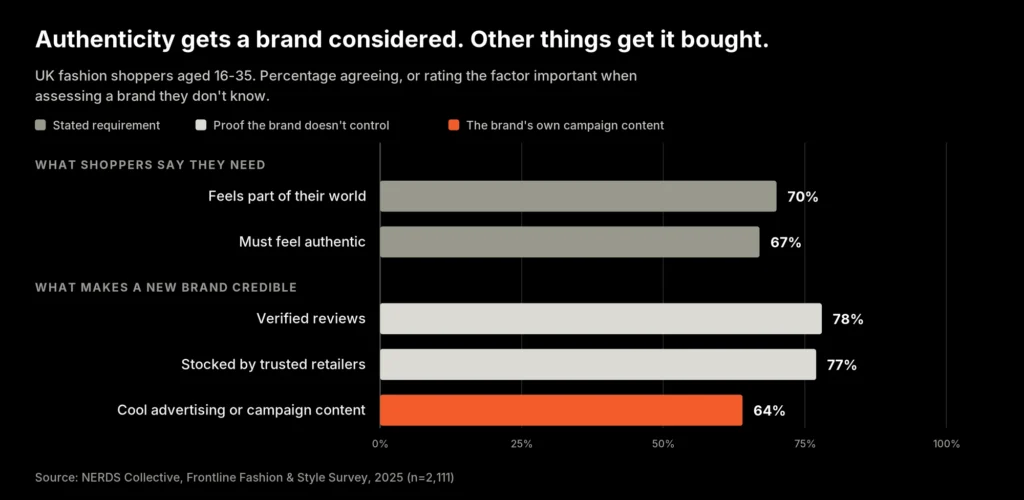
For brands tracking youth marketing trends, the commercial implication is clear: creative work cannot complete the credibility job on its own. Distribution and social proof are carrying more weight than many campaign plans allow for.
What this means for brands: For challenger and emerging brands especially, retailer strategy is part of brand strategy. Where a product is stocked, what verified buyers say and how easy it is to evaluate the product can communicate legitimacy before a campaign has a chance to do so.
4. Young Consumers Want Distinctive Brands, Not Just Limited Drops
The industry’s default response to ‘young consumers want something different’ has often been limited supply. The data suggests the desire for distinction is stronger than enthusiasm for any single mechanic used to create it.
Among UK streetwear fans aged 16-35, 70% wanted brands not everyone else has, but only 52% preferred limited-edition products or drops.
Source: NERDS Collective, Frontline Fashion & Style Survey, 2025 (UK streetwear fans aged 16-35, n=358)
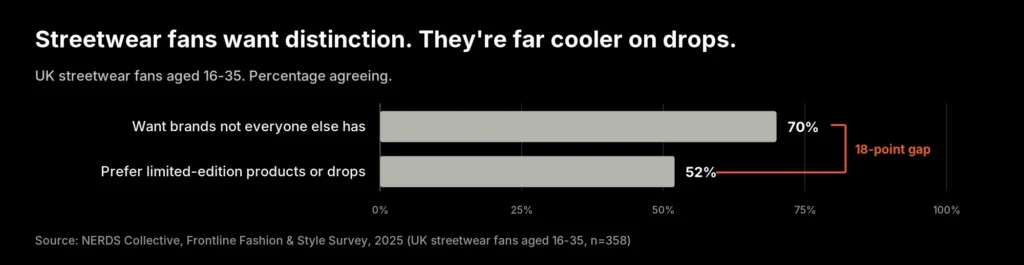
That is an 18-point gap between the desired outcome and one familiar route to achieving it. Drops can still work, but they are a tool for distinction rather than its definition.
A brand can also create distinction through range architecture, styling, retailer exclusivity, locally relevant product or a point of view that deliberately is not designed for everyone. Brands over-indexed on artificial scarcity may be paying an operational premium for a benefit they could deliver in other ways.

5. Luxury Alone No Longer Defines Aspiration for Young Consumers
Asked which brand they would most choose if money were no object, UK fashion shoppers named Zara most frequently, with 193 mentions. Gucci followed with 160 and Nike with 134.
Source: NERDS Collective, Frontline Fashion & Style Survey, 2025 (n=2,111)
Removing the price constraint did not automatically push a luxury house to the top. A high-street retailer still outperformed both a luxury brand and a global sportswear name.
Across our wider global client work, aspiration is increasingly built across fashion, music, sport, digital culture and identity at the same time. Audiences read it through taste, cultural fluency and how naturally someone moves between those worlds, not through a single price or category signal.
What this means for brands: Premium positioning cannot be assumed to equal aspiration. High-street and accessible brands can compete through taste, speed and cultural fluency, while heritage brands still need to demonstrate why their status matters now.
6. Peers Influence Young Consumers More Than Celebrities
Understanding Gen Z consumer behaviour means separating platform reach from personal authority. Influence is distributed across platforms, peers and the people young consumers encounter in everyday life; reach alone does not show who carries authority with a particular group.
When UK fashion shoppers aged 16-24 were asked about the top influences on their personal style:
- 49% selected TikTok and 42% selected Instagram.
- 32% selected friends and people they know.
- 22% selected influencers or creators.
- 15% selected celebrities.
Source: NERDS Collective, Frontline Fashion & Style Survey, 2025 (UK fashion shoppers aged 16-24, n=903)
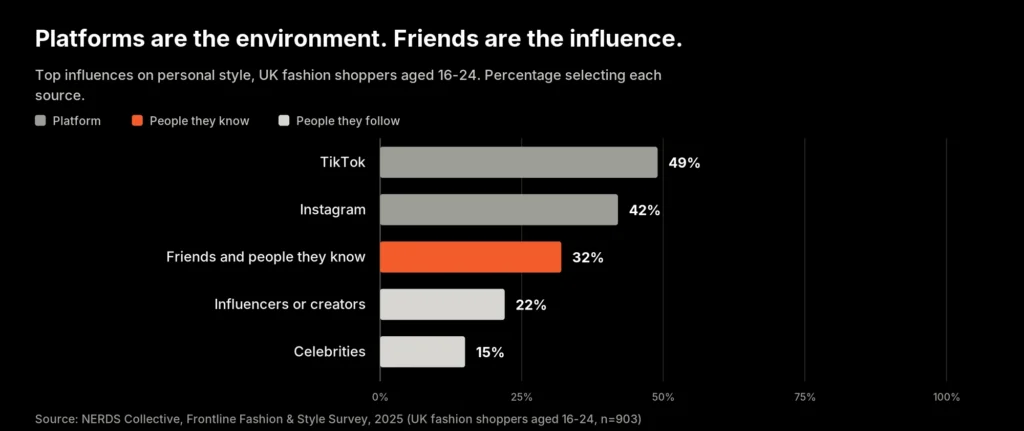
The pattern also appears in our Frontline Style & Culture Panel. Among UK 16-24-year-olds, 27% said they found inspiration in people they saw out and about and 23% looked to friends, compared with 17% for social media influencers and 8% for celebrities.
Source: NERDS Collective, Frontline Style & Culture Panel, 2024 (n=663, UK 16-24-year-olds)
Platforms remain powerful environments for discovery, but the individuals those platforms make famous are only one part of the influence system. Peer-level and scene-level authority is doing substantial work and is often unbought.
What this means for brands: The better question is not simply who has the largest audience. It is who has genuine authority with the specific community the brand needs to reach, and whether that authority comes from a creator, a peer network, a local scene or the platform itself.
7. Youth Culture Trends Differ by Market and Community
Across five European markets, our research for JD Sports found that scale and visibility were not automatically translating into cultural relevance. The brand was read differently by market and style community, with clear appetite for hyper-local content and partnerships connected to consumers’ own communities.
The same pattern appeared in our work with Puma. Local cultures and trends were more useful than national generalisations for understanding how young sportswear consumers decided what to buy. The research platform built for Puma therefore tested at three levels: the universal, the city and the individual retailer.
Gen Z trends cannot be interpreted through a global-or-local binary. The strongest structure is a global framework with locally determined expression, supported by research capable of showing which parts should remain consistent and which need to change.
What this means for brands: Over-globalise and the work can feel generic. Over-localise and the brand loses the efficiency and coherence that made scale valuable. The job is to identify where local difference genuinely changes the decision.
8. Young Consumers Expect Brands to Earn Cultural Legitimacy
Cultural legitimacy is different from purchase credibility. Credibility asks whether a brand can be trusted. Legitimacy asks whether it has a believable role in the audience’s world.
Among UK fashion shoppers aged 16-35, 70% said they look for brands that feel part of their world and 67% said brands must feel authentic.
Source: NERDS Collective, Frontline Fashion & Style Survey, 2025 (n=2,111)
‘Part of their world’ is a demanding standard. It is not awareness or passive approval. It means the brand’s behaviour, partnerships and decisions make sense within a particular set of people.
Young audiences have grown up around the machinery of marketing. They recognise seeded content and can see the gap between what a brand claims culturally and how it behaves when no campaign is running.
What this means for brands: Cultural legitimacy cannot be manufactured through creative alone. It is built through partner choice, product decisions, distribution, long-term investment in communities and the claims a brand chooses not to make.

What Is Not Changing
A useful report on youth trends should also name the things that have stayed put.
Product fundamentals still lead. In our research for Timberland, design ranked first among purchase considerations, followed by price and quality. Cultural relevance can make a brand a candidate; product, price and quality still help close the sale.
Young people still like brands. The idea of a generation in wholesale rejection of commerce does not survive contact with the data. Young consumers study brands, defend them, resell them and use them to signal identity. What they reject is behaviour that feels performative or opportunistic.
Scale still matters. None of these youth trends argues against reach. The point is that reach and cultural relevance are different achievements, and one does not automatically deliver the other.
How Brands Should Use Youth Trend Research
A trend report should change a decision, not simply provide a theme for the next post. Use each shift as a diagnostic question rather than an instruction.
1. Check the evidence: Review the age range, market, category, sample size and date before treating a finding as relevant to your audience.
2. Translate the shift into a business question: If validation is becoming more important, audit the information and proof available before purchase. Do not simply create campaign content about validation.
3. Test it in your category and market: A signal can be broadly important while its implication remains specific. Research what the behaviour changes for your product, audience and commercial model.
4. Look upstream: If a trend only changes the next social post, the analysis probably has not gone far enough. Meaningful shifts can affect product, distribution, partnerships, research and investment before assets are made.
5. Refresh the evidence: Young consumer trends move at different speeds. Revisit the data periodically and retire conclusions that are no longer supported.
Nationally representative research into Generation Z trends also has limits. A broad sample may contain too few people from the subcultures, scenes or local communities driving a category to support a useful decision. That is why we deliberately oversample relevant groups where the brief requires it, while stating the rationale and sample clearly.
The NERDS View
Most brands already have enough awareness of youth marketing trends. What they often lack is a reliable way to distinguish a behaviour that is merely visible from a shift that changes how value, trust or desire are built in their category.
These eight youth consumer trends are the ones we can currently evidence. They will evolve, which is exactly why youth consumer research needs to stay connected to the people and communities shaping what happens next.
Frontline gives brands direct access to those audiences through our proprietary research engine. If your next decision depends on knowing what young consumers are doing before it becomes obvious, talk to our team.
FAQs
How can brands tell whether a youth consumer trend is a lasting behaviour change or a short-lived viral moment?
A lasting youth consumer trend changes what young people repeatedly do, value or buy; a viral moment primarily creates a temporary spike in attention.
Brands should look for four signals:
- The behaviour continues after the original content or format has peaked.
- It appears across multiple communities, platforms or research methods.
- Young consumers are changing decisions, routines or spending because of it.
- The trend reflects a deeper need or tension that will remain relevant even if its current expression disappears.
A viral moment can still create a useful marketing opportunity, but it should not automatically be treated as evidence of a wider change in young consumer behaviour.
Can a youth consumer trend affect purchasing before it becomes mainstream?
Yes. A youth consumer trend can influence product discovery, evaluation and purchasing before it achieves widespread public visibility.
Early commercial signals may include:
- Repeated product requests or recommendations
- New language appearing in category searches
- Increased review and comparison activity
- Changes in the criteria young consumers use to assess products
- Growing demand within a specific retailer, market or community
These behaviours may be commercially significant while overall search or social-media volume remains low. Mainstream visibility can help confirm scale, but it should not be the only threshold used to decide whether an emerging trend matters.
What is the difference between a youth culture trend and a youth consumer trend?
A youth culture trend changes how young people express identity, communicate, spend time or participate in communities. A youth consumer trend affects how they discover, compare, purchase, use or recommend products and brands.
The two can be connected, but they are not interchangeable. A cultural shift becomes commercially relevant when it begins to influence decisions such as:
- Which products young people consider
- What they view as valuable or credible
- Where they look for recommendations
- Which brands they are willing to buy from
- What they expect before completing a purchase
Not every cultural trend creates a consumer trend, and brands should establish the commercial connection before acting.
What evidence should a brand have before investing in a Gen Z consumer trend?
A brand should have enough evidence to show that a Gen Z consumer trend is relevant to its audience, category and proposed investment. There is no universal engagement figure or sample size that makes a trend commercially significant.
Before investing, brands should establish:
- Whether the signal appears in more than one source or community
- Whether it is changing behaviour rather than language alone
- Which audience is driving it and how commercially relevant that group is
- Whether it fits the brand’s product, positioning and capabilities
- What would need to happen for the investment to succeed
The evidence threshold should reflect the risk. Testing a piece of content requires less proof than changing a product range, partnership strategy or retail model.
NERDS uses Frontline to investigate emerging signals directly with young people and cultural contributors, then applies qualitative and quantitative research to understand how widely a finding may extend.
How can brands tell whether a youth trend is driving purchases rather than simply generating attention online?
Brands can distinguish purchasing behaviour from online attention by connecting cultural signals with actions taken throughout the customer journey.
Relevant indicators may include:
- Changes in category and branded searches
- Product-page visits and engagement
- Review consumption and comparison activity
- Wishlists, saved products and stock notifications
- Retailer or stockist searches
- Conversion and repeat-purchase data
- Direct feedback explaining why young consumers chose a product
Views and engagement demonstrate visibility, but they do not prove purchase intent. Combining behavioural data with youth consumer research provides stronger evidence of whether a trend is genuinely changing consumer decisions.
Do youth consumer trends apply equally to everyone aged 16-25?
No. People aged 16-25 should not be treated as a single, uniform consumer group.
Teenagers, students, early-career workers and young adults living independently can have significantly different needs and purchasing power. Gen Z consumer behaviour is also shaped by factors including:
- Location and local culture
- Income and life stage
- Interests and community membership
- Product category
- Personal identity
- Access to platforms, retailers and experiences
The age range provides a useful research boundary, but it is not a complete audience segment. Findings should always state who was included and be analysed by the characteristics most relevant to the decision.
When should a brand choose not to respond to a youth culture trend?
A brand should avoid responding to a youth culture trend when it lacks a credible role, cannot add value or has insufficient evidence that the trend matters to its audience.
Warning signs include:
- The trend is supported by a single short-lived spike.
- The brand has no meaningful connection to the community driving it.
- Participation would expose or commercialise a space valued for its privacy.
- The idea conflicts with the product or established brand behaviour.
- Internal approval or production timelines mean the response will arrive too late.
- The execution benefits the brand without benefiting the people behind the trend.
Understanding current trends in youth culture does not always require public participation. Sometimes the strongest decision is to apply the insight elsewhere and leave the cultural expression alone.
Keep Exploring Youth Culture
Youth consumer trends are one part of a much wider cultural system. These guides explore where emerging behaviours develop, who gives them meaning and what brands should do with that understanding: